
How to Choose the Right Air Duct Cleaning Company in Draper
Most homeowners in Draper pick a duct cleaner the way they pick a pizza place: whoever answers first and quotes lowest. That’s the wrong filter. Choosing an air duct cleaning company in Draper comes down to one verifiable question: what equipment will be physically inside your home, and can the technician name it? If the answer is vague, so is the cleaning. If you’d rather not sort through the noise yourself, call (855) 658-5334 and we’ll walk you through what a real quote should include.
Why Equipment Is the Only Credential That Actually Matters
Certifications are useful signals. Equipment is the actual work. NADCA certification sets training and procedural expectations, but it does not specify minimum equipment standards. A certified technician can legally run a shop vacuum and call it duct cleaning. Independent industry testing has found that the wrong setup leaves 60 to 70 percent of debris undisturbed, which is a nice way of saying you paid for the light dusting and not the cleaning. Your ducts are only as clean as the machine doing the work.
Here’s a simple equipment test. Ask the technician to name the vacuum unit, the agitation tool, and the containment system, right there on the phone. A trained technician answers in seconds. A salesperson pivots to pricing. In our experience, the equipment story is where the honest contractors separate from the rest.
- Extraction vacuum: a HEPA-rated unit with a stated CFM rating, not a shop vacuum. Nikro HEPA machines are a solid benchmark to ask for.
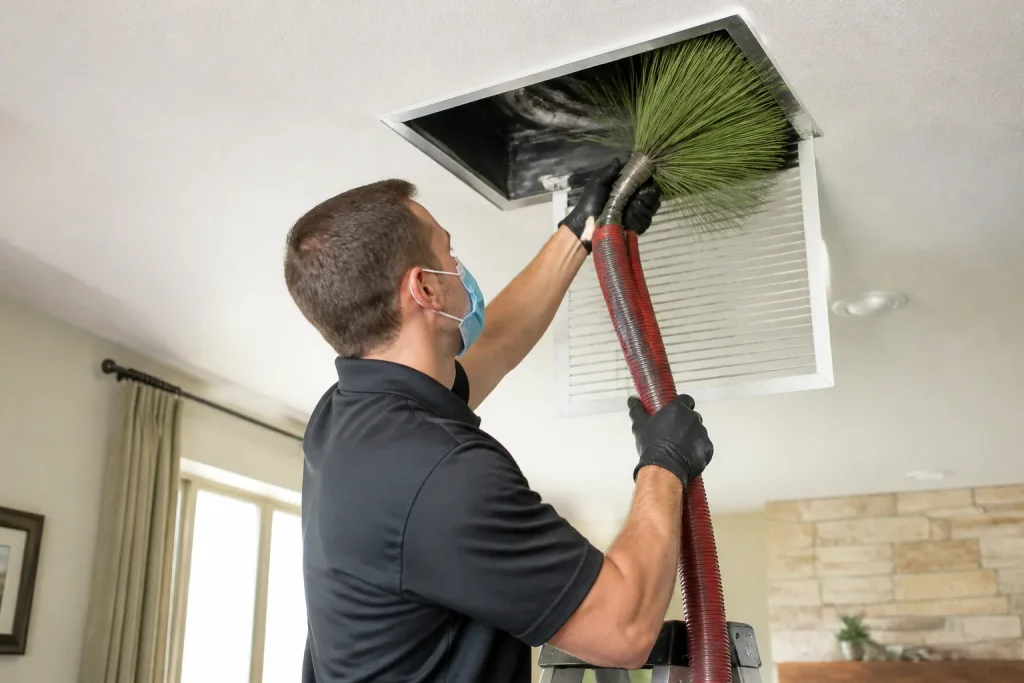
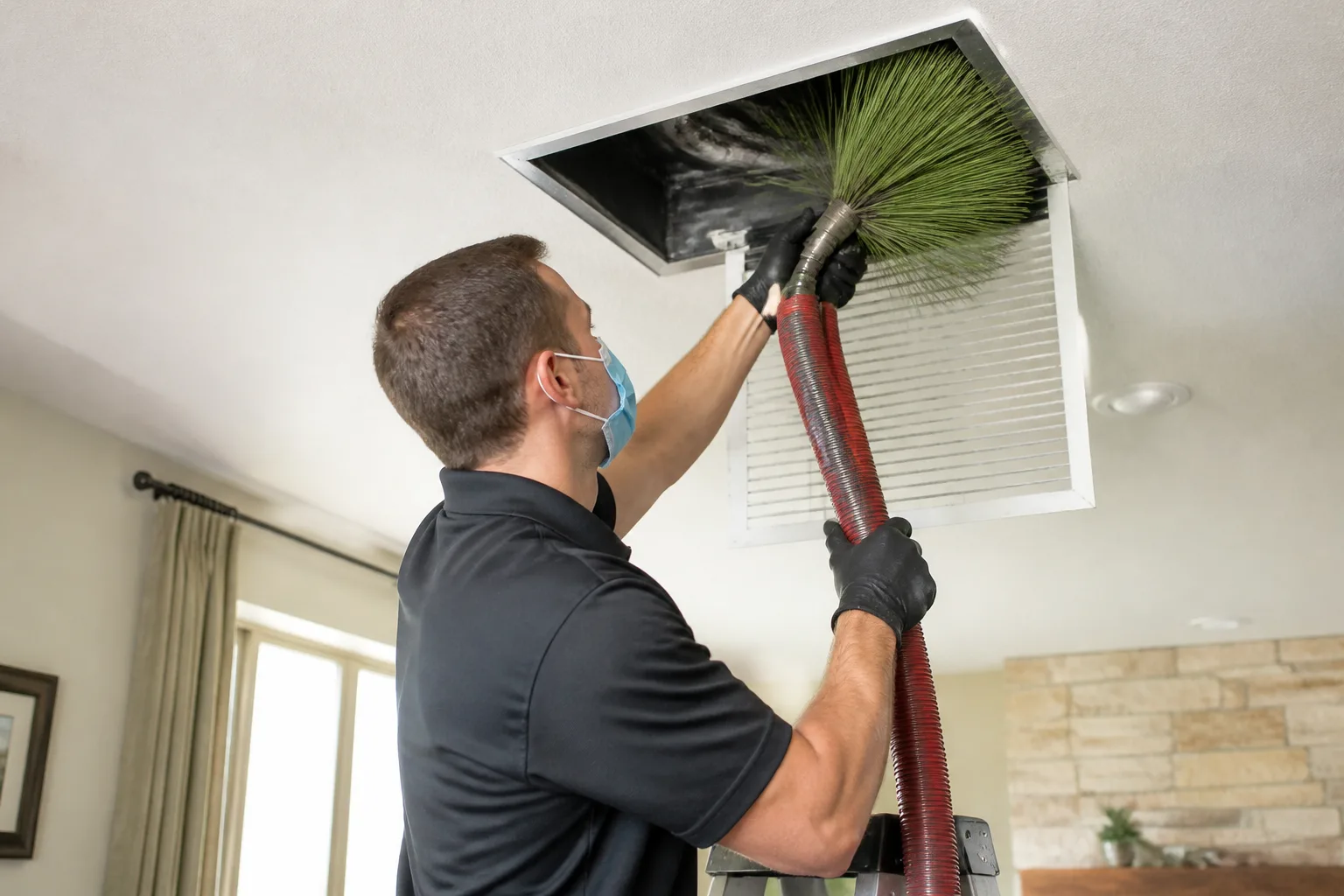
- Agitation: rotary brush contact cleaning or compressed-air whips. Suction alone doesn’t loosen caked debris; something has to break it loose first. Rotobrush contact-cleaning systems are what many HVAC contractors use for this.
- Containment: negative-pressure equipment that captures what’s dislodged instead of blowing it back into your living room. Abatement Technologies negative-air tools are the professional standard here.
Notice that none of those are consumer brands. If a company can’t tell you which one they use, that’s your answer.
The Three Questions to Ask Any Draper Contractor Before You Book
You don’t need a technical background to spot a weak operation. You need three specific questions. Ask these in the same phone call, and pay attention to whether the answers are specific or fuzzy.
- What’s the CFM rating of your vacuum unit? Airflow is the whole game. If they don’t know the number or can’t find it, the unit likely isn’t rated for professional duct work.
- Do you use mechanical agitation, and what kind? Look for a rotary brush or air whip. “We use strong suction” is not an answer; it’s a deflection.
- How do you establish negative pressure? The point is to keep your home cleaner during the job, not just the ducts afterward. Negative-air containment is the difference between a cleaned house and a dusty one.
Run these three questions in Draper and you’ll narrow the field fast. The company that answers all three without hesitating is worth a second call. The one that offers a coupon instead is not.
How to Read a Duct Cleaning Quote
Vague quotes are the tell. A legitimate air duct cleaning proposal in Draper should spell out scope in concrete terms, not just a number and a “call today” line. If the quote is one sentence and the price is one number, you’re about to get one service: whatever the technician decides is easiest.
What a real quote includes:
- Vent count: how many supply and return registers are being cleaned. A per-vent structure is common, but the total should be written down before work starts.
- Linear footage estimate: square footage of ductwork is not the same as linear footage. A professional estimate references the actual run length, especially in larger homes.
- Named sanitizer product: if sanitizing is included, the product name should be printed on the quote. “A sanitizer” is not a product.
- Scope of inspection: does the price include a look at duct condition, or only vacuuming? Those are two different jobs.
For a fuller picture of what’s typically involved, our air duct cleaning page lays out the standard scope we use on Draper jobs. If the quote you’re holding doesn’t match it, ask why.
Duct Cleaner vs. Full-System Contractor
A duct cleaner vacuums ducts. A full-system contractor cleans, inspects, repairs, seals, and sanitizes the entire duct and HVAC system. Those are two different categories of company, and only one of them can fix what the cleaning reveals. When the rotary brush finds a seam that’s separated or a run that’s crushed behind a wall, a vacuum-only operator hands you a business card and leaves.
Ask before you book: can they repair and seal ductwork, or only clean it? Can they clean the HVAC equipment itself (the blower, coil housing, and cabinet), or only the ducts? A company that handles both doesn’t need to call a second contractor for the repair, which means one visit, one scope, one invoice. For a system-wide service, our HVAC cleaning page covers what full-system cleaning looks like.
What Draper Homes Specifically Need from a Duct Cleaner
Draper isn’t one housing stock. Homes up the hill toward Traverse Mountain are newer and often have longer duct runs across multiple levels, which means more joints, more turns, and more places for debris to settle. Ducts that long tend to collect buildup in the runs furthest from the air handler, which is exactly where cheap equipment stops reaching. Homes in the older Draper city core often have original or older flex duct. Some of that is fine. Some of it has been compressed, kinked, or has seams that have come loose, and those runs need inspection, not just vacuuming.
Utah’s dry climate matters here too. Dry air doesn’t create moisture problems the way humid climates do, but household dust in Draper homes is fine and plentiful, which means the filter and return system has to work harder than homeowners expect. That’s another reason to want mechanical agitation and a rated vacuum; fine particulate needs negative pressure to capture it, not a shop vac that just stirs it up.
One more note for Draper homeowners: the dryer vent is part of the picture. A clogged dryer vent is a fire risk, not just a slow-dry annoyance. Our dryer vent cleaning page covers that separately, and we recommend treating it as its own service, not an afterthought on the duct invoice.
Three Contract Terms to Insist On
You wouldn’t hire a contractor without a written scope, and duct cleaning is no different. Three terms protect you from the most common failure modes.
- Pre- and post-cleaning photos: before and after shots of your own ducts, not stock images from a brochure. Photos are the only verifiable proof the work was done in the places you can’t see. If a company won’t provide them, that’s a red flag.
- Written equipment list: the specific machines scheduled for your job. This is the same test from section one, but on paper. A written list is a commitment; a verbal one is a maybe.
- What happens if mold or damage is discovered: the contract should state, in plain terms, what the company does when it finds something that needs a different service. Do they stop and quote the repair? Refer it out? Pretend they didn’t see it? Insist on an answer in writing.
Those three terms turn a handshake into a scope. They’re also the terms that make a discount quote start to look expensive.
When to Call a Pro
Some signs are worth acting on without waiting for a “best time” to schedule. Visible dust blowing from registers after a recent cleaning, musty odors in specific rooms, a dryer that takes two cycles to dry a load, or noticeably uneven airflow between rooms are all signals the system needs attention. If you’re seeing any of these, call (855) 658-5334 and describe what’s happening; we’ll tell you whether it sounds like duct cleaning, dryer vent service, or something that needs an inspection first.
If you’d rather learn more about how we approach the whole system, see Draper Air Duct Cleaning for the full service picture.
The Bottom Line
The right duct cleaning company in Draper is the one that can name its equipment, write a real scope, and show you before-and-after photos of your own ducts. Certifications are fine. Reviews are useful. Neither replaces the answer to “what machine is coming into my home?” If the answer is specific, you’re probably in good hands. If it isn’t, keep calling.
If you’re in Draper and need help, Draper Air Duct Cleaning offers free estimates. Call (855) 658-5334. We answer 24/7, with fast dispatch from 7am to 7pm. One call covers the whole system, from cleaning and sealing to sanitizing and dryer vent service. Our technicians have up to 13 years of experience, and we use professional-grade Rotobrush, Nikro, and Abatement Technologies equipment, not big-box tools.
Frequently Asked Questions
Ask for pre- and post-cleaning photos of your own ducts, taken inside the system, not stock images. Compare the two sets and confirm the photos match the vents in your home. A company that hesitates on photos is a company to skip. Call (855) 658-5334 if you want to see what that documentation looks like before you book.
Cheap quotes usually mean cheaper equipment: a shop vacuum instead of a HEPA-rated unit, no mechanical agitation, and no negative-pressure containment. That setup leaves most of the debris where it started. The price reflects the tool, not a discount.
No. NADCA certification speaks to training and procedure, but it doesn’t set a minimum equipment standard. A certified technician can still run consumer-grade gear. Treat certification as one signal, and always verify the equipment separately.
Yes, if you hire a full-system contractor rather than a vacuum-only operator. Cleaning, repair, sealing, and sanitizing under one provider means no second call when the inspection turns up a loose seam or damaged flex run. Ask upfront whether they handle repairs before you schedule.
Written by the team at Draper Air Duct Cleaning.
Need Air Duct Cleaning Help?
Call Draper Air Duct Cleaning - the local pro we connect you with is licensed and insured, with free written estimates in Draper.
(855) 658-5334