
Abatement Technologies Air Duct Cleaning in Draper: A Homeowner’s Guide
Most homeowners in Draper only learn one thing about their duct cleaner’s vacuum: how loud it is. That’s the wrong question. The right one is what the machine’s filter actually catches. A standard duct cleaning vacuum is built to trap particles down to roughly 1 micron. Abatement Technologies HEPA units are rated to capture particles down to 0.3 microns, and that gap is exactly where mold spores and fine combustion particles sit. If you’re comparing duct cleaning quotes in Draper and the equipment never comes up, you’re comparing the wrong number. If you’d rather have someone walk the system with you, call (855) 658-5334.
What Is Abatement Technologies Equipment, and Why Does It Show Up in Duct Cleaning?
Abatement Technologies builds HEPA filtration and negative-air containment equipment for mold and asbestos remediation. That’s the origin. Contractors working in contaminated spaces needed a way to pull air through a filter fine enough to stop spores from traveling and to hold a room under negative pressure so disturbed particles couldn’t escape into the rest of the building. Those same requirements apply to a dirty duct system in a Draper home.
When that equipment gets adapted for duct work, three things follow:
- Finer filtration. A HEPA-rated machine captures the particle sizes that standard rigs let pass back into the room.
- Negative pressure. The system is held under vacuum so air moves toward the machine, not out of the registers into your living space.
- Containment discipline. The job is planned around keeping debris where it started until it’s removed and sealed in a bag.
A standard setup, like a Rotobrush rotary contact cleaner paired with a Nikro HEPA-rated machine, handles the ordinary case well. Rotobrush scrubs the duct walls with a rotating brush head, Nikro brings HEPA-rated filtration to the collection side, and for a typical dusty forced-air system that combination is the right tool. Abatement Technologies equipment enters the picture when the contamination load is high enough that containment stops being optional.
Which Draper Homes Actually Need Abatement Technologies Equipment?
Not every house does. This is where a lot of marketing goes sideways, because a contractor who owns the equipment has an obvious reason to recommend it. Here’s the honest breakdown we use when we’re looking at a Draper home.
Standard Rotobrush and Nikro is usually enough
If your ducts have ordinary dust and debris built up over years of normal living, the standard rotary-plus-HEPA combination will get the system clean. Draper sits in a high-desert valley with long dry summers and steady construction dust, so ducts here do load up faster than in wetter climates, but that’s a volume problem, not a containment problem.
Where Abatement Technologies equipment is the correct call
- Post-renovation contamination. Drywall dust, insulation fibers and fine silica from a remodel settle into return ducts and stay airborne for a long time. These particles are small and abrasive.
- Confirmed or suspected mold growth. Visible growth around registers, a musty smell when the system starts, or moisture problems from a leak or high indoor humidity all point to a system that needs containment, not just vacuuming.
- Households with allergy, asthma or immune concerns. When the stakes are health-related, the goal shifts from “cleaner ducts” to “documented particle removal.”
- Fire or smoke residue. Fine combustion particles sit in the same size range HEPA units are designed to catch.
Draper has a wide spread of home types, from older properties near the Historic Park area to newer builds out toward SunCrest and the foothills, and duct conditions vary a lot between them. A sealed return system in a newer home behaves differently from one that’s had pri
How Negative-Pressure Containment Works in Practice
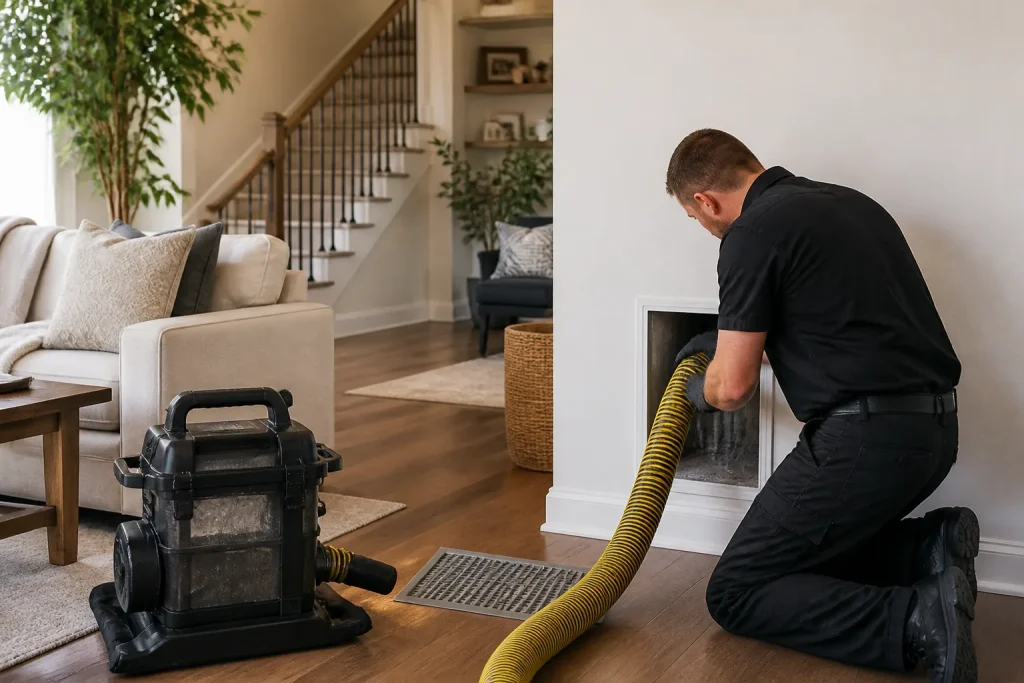
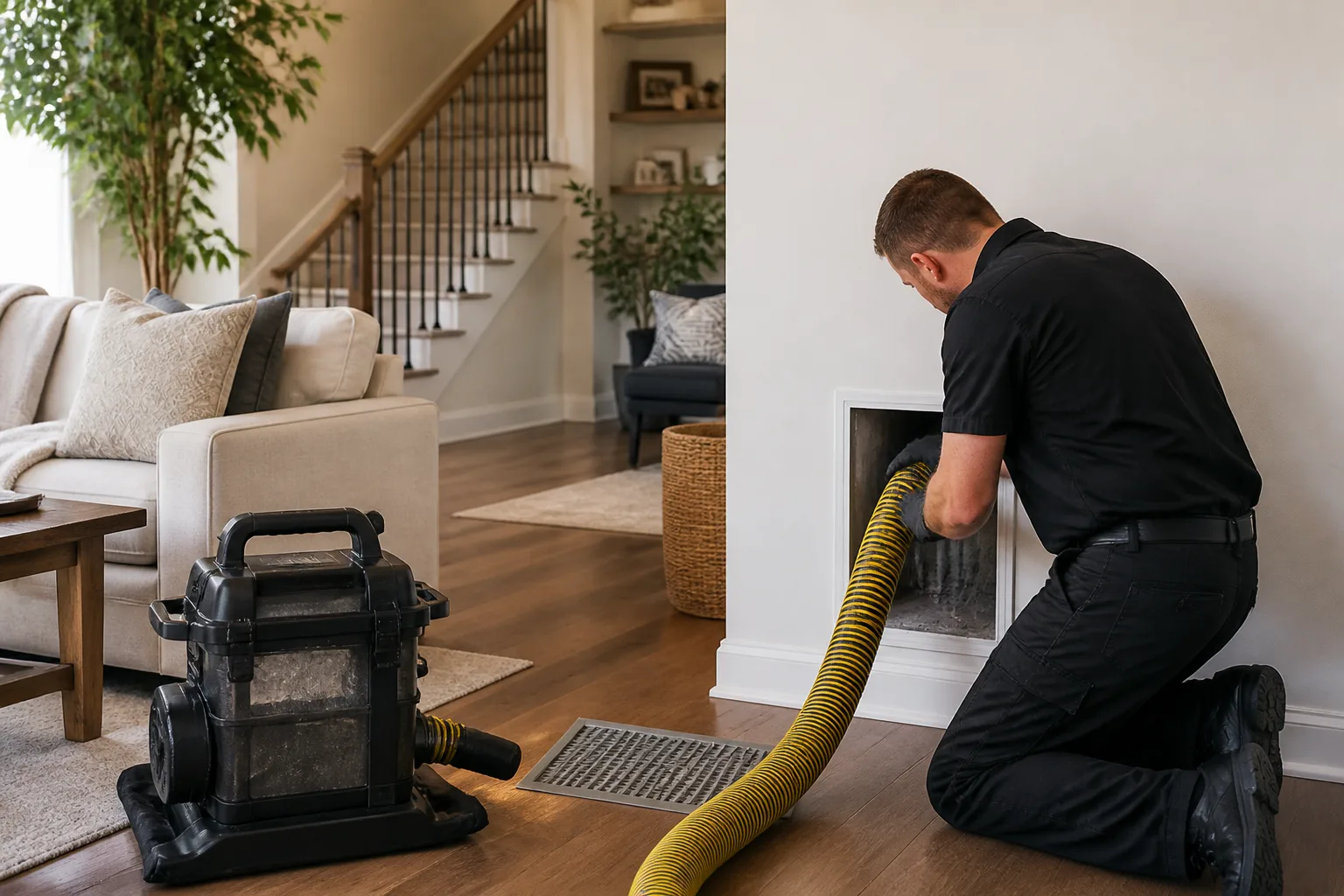
The concept is simple. The execution is where jobs succeed or fail. Negative-pressure containment means the duct system is sealed and connected to a HEPA vacuum unit, then airflow is established in one direction so every particle loosened during cleaning travels toward the machine instead of into a bedroom.
What that involves on a real job:
- Sealing the system. Registers, returns and access points get covered or taped so the only open path into the ducts is the one connected to the vacuum.
- Establishing airflow direction. The vacuum creates suction at the collection point while technicians work from the far end of each branch, so loosened debris moves toward the capture point as it’s disturbed.
- Working in segments. Each trunk and branch is handled in order. You don’t open the whole house at once.
- Containing the work area. Plastic sheeting and negative air machines keep the immediate space under pressure while access panels are open.
- Removing debris in sealed containers. Nothing comes back through the house to get to the truck.
If your ducts are only as clean as the machine doing the work, the filter and airflow control are what make that true. Cleaning without containment just moves dust from the ducts to the furniture.
What You Should See and Hear During an Abatement Technologies Job
You don’t need to supervise, but you should know what a proper job looks like. Here’s what’s normal when the equipment is right.
- Audible vacuum draw at registers. Hold a hand near an uncovered supply or return and you should feel steady suction. Consistent draw across the system tells you the containment is working.
- Sealed returns and covered registers. Most openings should be taped off during the job. If everything is wide open and the vacuum is running, ask why.
- Technicians in appropriate PPE. For remediation-grade work that means respirators, gloves and protective suits, not a t-shirt and a shop vac hose.
- An access plan. Some jobs require cutting small access panels in the ductwork to reach sections the brush can’t, then sealing them afterward. Expect a conversation about that before it happens.
- Plastic sheeting at doorways. Containment in the work area should be visible.
If you hear a vacuum starting and stopping constantly, or see debris puffing out of an open register, something is off. Speak up. A competent crew will explain the setup before they start, not after. The same care applies to HVAC cleaning, because the air handler, coil and blower need the same containment when they’re cleaned.
How Do You Verify the Job Worked After the Equipment Leaves?
A credible contractor confirms containment held. There’s no single required test, but here’s what verification looks like on a proper remediation-grade duct cleaning.
- Visual inspection. Camera or direct inspection of the trunk and representative branches after cleaning, so you can see the interior condition rather than take someone’s word for it.
- Before-and-after photos. Photos of your own ducts, not stock images. Ask for them, and check that the angles match.
- Air quality check. Particle counting or a similar check in the living space before and after cleaning tells you whether the containment actually worked.
- A final register pass. Confirm every register and return was cleaned and resealed, and that no access panels were left open.
- A walkthrough with you. Someone should walk the system with you, explain what was found, and discuss any duct sealing or repair needed.
Air quality you can verify is the whole point. That’s also where the broader system matters. If ducts are clean but the air handler and coil are dirty, and your filtration is undersized, dirt comes right back. We work with Honeywell and Aprilaire filtration products for exactly that reason, because filtration upgrades are how a clean system stays clean.
When to Call a Pro (and What Else in the System Needs Attention)
Housekeeping has limits. If you’re seeing debris blow out of a register when the heat comes on, smelling something musty when the system starts, or you’ve just finished a remodel, that’s the point to stop guessing and get the system looked at.
Related services in Draper
Duct cleaning rarely stands alone. Our air duct cleaning service covers the full system, and if your cleaning reveals gaps or disconnected joints, duct repair and sealing fixes the leak before it pulls attic air into the house. Separately, our dryer vent cleaning is a dedicated service, not an upsell, because a clogged dryer vent is a documented fire hazard.
For anyone who wants the full picture of how we approach a home in the valley, our Draper Air Duct Cleaning page is the place to start. And yes, those are two different services. One cleans the air you breathe. The other keeps your lint from becoming the reason a fire truck visits your street.
The Bottom Line
Abatement Technologies equipment matters because HEPA filtration and negative-pressure containment change what a duct cleaning job can actually remove. If your Draper home has ordinary dust, a standard Rotobrush and Nikro setup will do the job. If you’ve had a renovation, a mold concern, or someone in the house with breathing issues, the finer capture and containment discipline of remediation-grade equipment is the right call. Every job should end with the same check: photos of your own ducts, a walkthrough, and a system that’s clean, sealed and sanitized rather than just vacuumed. Our technicians have up to 13 years of experience and handle cleaning, repair, sealing and sanitizing under one team.
If you’re in Draper and need help, Draper Air Duct Cleaning offers free estimates – call (855) 658-5334. We answer 24/7. Fast dispatch from 7am to 7pm, Sunday through Friday.
Frequently Asked Questions
No. Standard Rotobrush rotary cleaning with a Nikro HEPA machine handles typical dust buildup in most Draper homes. Abatement Technologies equipment is the right choice when contamination is heavy, such as after a renovation, with mold growth, or in households with allergy or asthma concerns, where finer particle capture and negative-pressure containment matter more than raw cleaning power.
We price the job per system, not per vent, and the written estimate sets the final number. Cost depends on system size, the number of branches, contamination level and whether access panels are needed. The estimate is free. Call (855) 658-5334 for an exact quote.
Usually because they’re cleaning without real containment. A low quote typically means a smaller vacuum, no HEPA filtration, and no negative pressure, so debris gets knocked loose and redistributed through the house. That’s exactly the bait-and-switch reputation this trade has earned, and it’s why we quote one flat price per system agreed before work starts and show before-and-after photos of your own ducts.
Ask for before-and-after photos of your own duct interiors, a post-job visual inspection, and a walkthrough at the end. Air quality verification, such as particle counting in the living space, is a good extra check after remediation-grade cleaning. If a contractor can’t show you what was removed and confirm the containment held, that’s your answer.
Written by the team at Draper Air Duct Cleaning.
Need Air Duct Cleaning Help?
Call Draper Air Duct Cleaning - the local pro we connect you with is licensed and insured, with free written estimates in Draper.
(855) 658-5334