
Emergency Air Duct Cleaning Near Me: What Draper Homeowners Should Do First
If you’re searching for emergency air duct cleaning near me in Draper, the first thing to do is stop the HVAC system. Turn the thermostat to off, not just fan, and seal the supply and return registers before anyone walks through the door. Running the blower after a sewage backup, a rodent intrusion, or fire residue turns a contained problem into a whole-house contamination event. If you’d rather not handle the shutdown steps yourself, call (855) 658-5334 and we’ll walk you through them.
Most people find us on their worst day: a smoke smell that won’t leave, an odor coming from a return vent, or evidence that something has been living in the ductwork. The instinct is to book the fastest cleaner available. The better instinct is to slow down for twenty minutes, do three things right, and only then call. That short pause is what separates a clean recovery from a system that keeps spreading the problem for weeks.
Which duct situations are true emergencies and which can wait?
Only three duct situations in a Draper home qualify as true emergencies: fire or smoke residue inside the system, a biohazard intrusion (sewage backup, animal waste, or a decomposing animal in the ductwork), and a sudden mold discovery on duct surfaces or insulation. Everything else – dust buildup, a bit of debris near a register, seasonal mustiness – can wait for a scheduled appointment.
Here’s how to tell them apart:
- Smoke or fire residue: Emergency. Ash and soot particles are fine enough to travel through every branch of the system and settle into insulation where a normal vacuum won’t reach.
- Biohazard intrusion: Emergency. Sewage backup or rodent waste carries pathogens, and the HVAC fan distributes them.
- Visible mold on ducts or insulation: Emergency if the affected area is larger than a small patch or the smell is persistent. Otherwise, treat it as urgent-but-schedulable.
- General dust, pet hair, seasonal odor: Not an emergency. Book a normal cleaning.
Draper homes sit in a dry, high-desert climate at roughly 4,500 feet of elevation. That matters for the mold question. Mold here needs a moisture source to get going – usually a leaking coil, condensate line, or a bathroom fan venting into the attic rather than outside. Once it takes hold, the low humidity actually slows airborne spore spread compared to a damp lower-elevation Utah Valley home, but it does not stop it inside a duct where condensation collects. We see more mold in Draper ductwork tied to a hidden moisture problem than to ambient humidity.
What should you do in the first hour after a duct emergency?
Your first-hour job is isolation, not cleaning. Shut the system down, seal the openings, and document everything before a contractor arrives. This protects your family and gives your insurance claim a fighting chance.
- Turn the thermostat to OFF. Not “fan on.” Not “auto.” Off. The blower is the delivery vehicle for whatever’s in the ducts.
- Seal the supply and return registers. Painter’s tape and plastic sheeting work fine. You’re stopping air migration between rooms.
- Photograph everything. The register, the visible contamination, the source (the sewage line, the rodent entry point, the mold patch). Date the photos.
- Don’t run a shop vac in the room. A standard vacuum exhausts fine particles back into the air. It makes the documentation photos worse and the problem bigger.
- Keep people and pets out of the affected rooms until a professional has assessed the system.
- Call your insurer early. Ask what they need documented before work begins.
Do these six steps in Draper and you’ve already prevented most of the cross-contamination that turns a single-room problem into a whole-house job.
Why does emergency work need HEPA containment, not a standard cleaning rig?
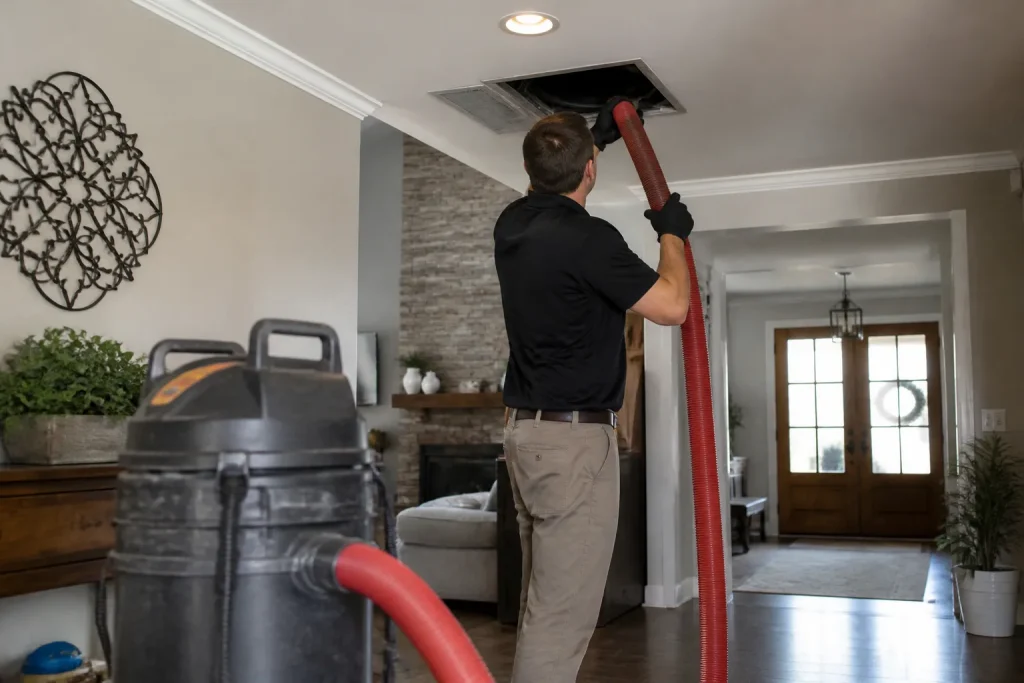
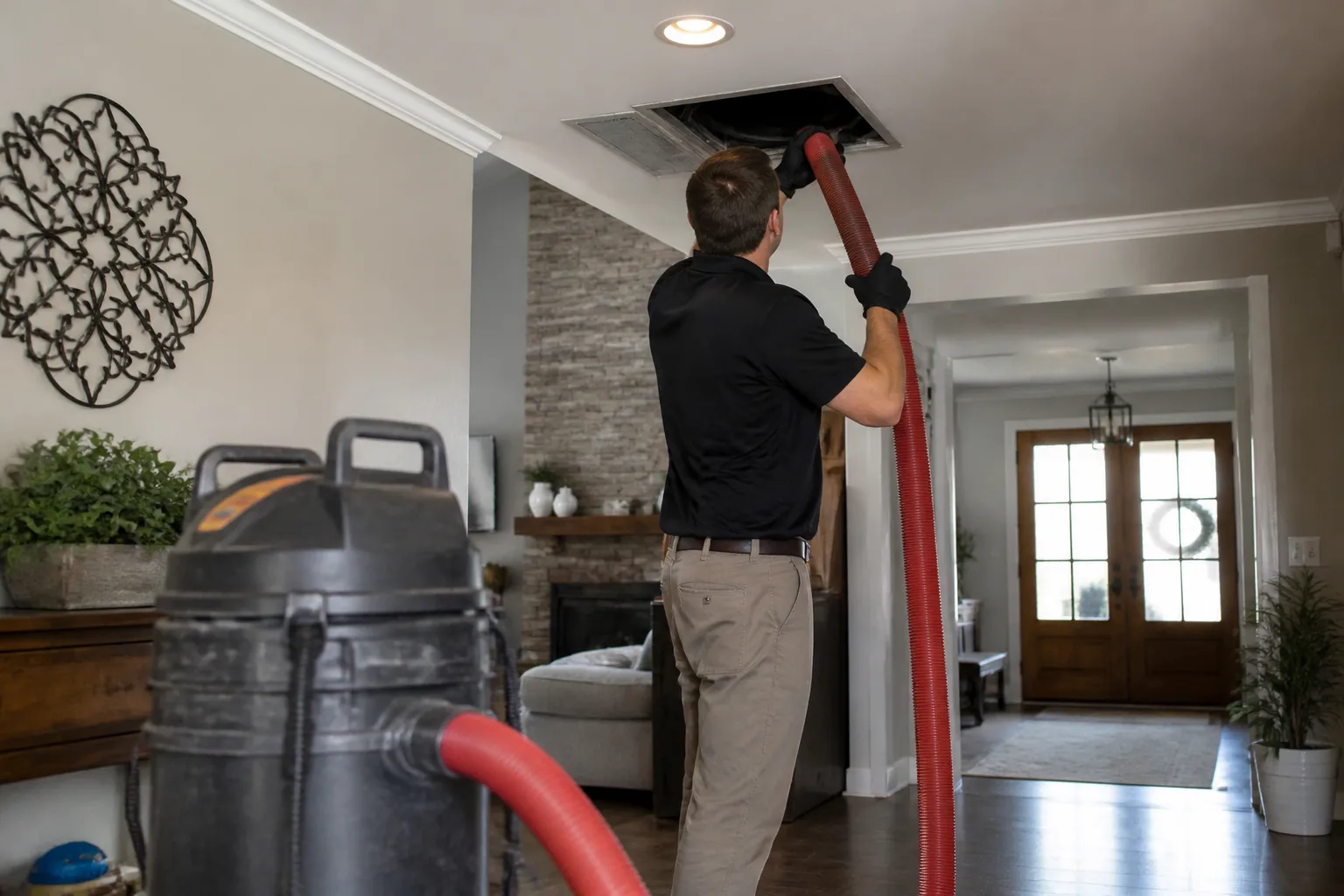
Standard duct cleaning equipment is built for scheduled work in a system that’s already stable. Emergency work is different: the contaminants are actively dislodged and airborne, and they need to be captured at the source. That’s why our emergency response uses Abatement Technologies negative-air containment equipment alongside Nikro HEPA-rated machines – to pull contaminated air into a filtered unit and hold it there rather than pushing it into living spaces.
The distinction matters most in the first thirty minutes of a job. When a technician opens a register on a system with settled rodent waste or mold spores, the disturbance sends particles airborne instantly. A negative-air setup creates a pressure differential that keeps those particles moving toward the HEPA filter instead of out into the hallway. A standard cleaning rig without containment does the opposite: it moves a lot of air, but it doesn’t control where that air goes.
Our regular scheduled work uses Rotobrush rotary contact-cleaning systems – the same equipment professional HVAC contractors rely on – but for emergency contamination we pair contact cleaning with containment because the risk profile is different. Your ducts are only as clean as the machine doing the work, and the containment is what keeps the work from becoming someone else’s problem.
When to call a pro: the moment you know it’s fire residue, biohazard, or visible mold, stop and call. We answer 24/7. Fast dispatch from 7am to 7pm, Sunday through Friday. A call outside dispatch hours is booked into the next opening.
What should you ask a same-day duct cleaner before they arrive?
Ask three questions and listen carefully to the answers: what equipment are you bringing, what is your containment protocol, and how will you verify the air quality afterward? A provider who can’t answer all three specifically isn’t set up for emergency work.
- “What equipment will be on site?” You’re listening for named professional-grade equipment (Rotobrush, Nikro, Abatement Technologies). If the answer is vague, ask again.
- “What is your containment setup?” Negative air containment or HEPA filtration should come up. If it doesn’t, that’s your answer.
- “How do you verify the job afterward?” Visual inspection plus air quality verification. “It’ll look clean” is not verification.
- “Is the estimate in writing before work starts?” It should be. A written estimate sets the final price, so you know the number before any equipment comes off the truck.
- “What’s your written scope of work?” Get it in writing. If a quote is verbal, it’s not a quote.
In our experience working across Draper, the providers who answer these questions clearly are the ones whose jobs hold up a year later. The ones who dodge them are the same ones whose first quote is a teaser number that grows.
How long can you wait before calling a professional?
For a confirmed emergency – smoke, sewage, rodent, mold – wait no more than a few hours and don’t run the system in the meantime. For a suspected problem (a smell you can’t place, a visible patch you’re watching), a scheduled appointment within the week is fine. The test is whether contamination is actively being circulated or sitting contained.
Draper homeowners often ask whether a duct emergency can be handled on a Saturday. We’re closed on Saturdays in respect for the day of rest many households here observe, so if a problem surfaces then, seal the registers, shut the thermostat off, and call. We answer 24/7, and a call that comes in outside dispatch hours gets booked into the next opening, Sunday through Friday, 7am to 7pm.
One more thing worth naming: the elevation and dry climate here mean a mold problem that looks stable can still be growing beneath insulation where you can’t see it, fed by a leak you haven’t found yet. If the moisture source isn’t fixed, cleaning is temporary. A thorough job includes identifying why the contamination happened in the first place.
Why do cheap emergency quotes backfire?
Because emergency work is exactly the situation where a low bid costs the most. Contamination that isn’t contained during cleaning gets pushed deeper into the system, and a second, larger job follows. We won’t quote a teaser number. Our pricing is set per job by a written estimate, so the flat price is agreed before work starts.
When you’re comparing quotes on a Draper emergency job, ask what the estimate covers: containment equipment, HEPA filtration, verification, and disposal. A quote that skips any of those isn’t cheaper – it’s incomplete. Before-and-after photos of your own ducts are the honest way to confirm the job was done, and any provider worth hiring will show them to you.
Related services in Draper: for scheduled maintenance, see air duct cleaning. For lint buildup in the exhaust line, our dryer vent cleaning service covers a leading cause of residential fires. For coil and blower work, see HVAC cleaning, and for the full range of what we handle, visit Draper Air Duct Cleaning.
The Bottom Line
Emergency duct work is a triage problem, not a cleaning problem. Shut the system off, seal the registers, document for your insurer, and call a provider who brings HEPA containment to the job. Smoke residue, biohazard intrusion, and confirmed mold are the only situations that truly can’t wait – and for those, containment is what keeps a contained problem from becoming a whole-house one. Our technicians have up to 13 years of experience, and our work covers the full lifecycle: clean, sealed, and sanitized under one call.
If you’re in Draper and need help, Draper Air Duct Cleaning offers free estimates – call (855) 658-5334. We answer 24/7. Fast dispatch from 7am to 7pm, Sunday through Friday.
Frequently Asked Questions
There’s no fixed emergency rate – pricing is set per job by a written estimate after we see the system and the contamination source. A standard whole-system cleaning and a contained biohazard job are entirely different scopes, so the written estimate is what sets the final price, and it’s agreed before work starts. Call (855) 658-5334 for an exact quote. Estimates are free.
Yes. Turn the thermostat to off, not fan, and seal the supply and return registers with tape and plastic sheeting before anything else. Running the blower after a sewage backup or a smoke event is the single most common mistake that spreads contamination through the whole system. Then call us. We answer 24/7.
Yes, if the mold is on accessible duct surfaces and we can bring HEPA containment. If the mold is growing because of a leak or a condensate problem, cleaning alone won’t fix it – the moisture source needs to be addressed first, or the mold returns. In Draper’s dry climate, mold in ducts almost always traces back to a hidden leak rather than humidity. Call (855) 658-5334 to schedule an assessment.
Yes, and do it before anyone touches the system. Photograph the visible contamination, the source, and each affected register, and note the date. Insurers often want proof that the source existed before cleaning began. Our technicians can document the system condition on arrival, but your own dated photos are the most useful record. Call us to schedule and we’ll walk you through what to capture.
Written by the team at Draper Air Duct Cleaning.
Need Air Duct Cleaning Help?
Call Draper Air Duct Cleaning - the local pro we connect you with is licensed and insured, with free written estimates in Draper.
(855) 658-5334